
Episcopal Press and News
Exhibit Hails Cheyenne Episcopal Missionary
Episcopal News Service. December 13, 1984 [84251]
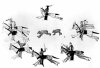
OKLAHOMA CITY (DPS, Dec. 13) -- A show featuring art by 19th century Episcopal missionary David Pendleton Oakerhater was on view at the Center of the American Indian in the Kirkpatrick Center here from Sept. 16 through Nov. 26.
Thirty-three ledger drawings were on loan from the Smithsonian Institution -- for their first outside exhibit. Support for the show was provided through grants from the Diocese of Oklahoma, the Episcopal National Committee on Indian Work, the Oklahoma Foundation for the Humanities, the Kerr Foundation and Fleming Companies, Inc.
The story of the drawings begins in 1875, when federal troops, answering the call of pioneers frightened by Plains Indian raids rounded up 72 suspected ring leaders. Among them was warrior called Making Medicine (Oakerhater's adult tribal name), a Cheyenne Indian.
Those arrested were sent as prisoners from Fort Sill, Okla. to Fort Marion in St. Augustine, Fla., at that time commanded by Captain Richard Pratt. Pratt, who later founded the Indian School in Carlisle, Penn. was sympathetic towards his prisoners. Although afterwards he came to oppose Indian culture, during his time at Fort Marion, Pratt allowed ceremonial dances in costume on special occasions and encouraged art among his charges, providing them with ledger books, crayons, pencils, watercolors and inks.
Some of the prisoners, including Making Medicine, had previously been painters in their tribes. Painting on hides and, toward the end of the 19th century, in more portable ledger books served both as a means of communication and as historical record of events important to the tribe, becoming more lifelike with increased exposure to European art. A picture-writing correspondence kept the Fort Marion captives in touch with their relatives and events in Oklahoma.
The Fort Marion drawings, including those of Oakerhater, reveal most of the characteristics of early hide paintings -- figures of horse and man in action; horse conventionalized with long, arching neck, small head, long body, legs spread before and behind to depict speed; man conventionalized with profile view but shoulders broadside, nose but no mouth or eye or hands with rigid straight posture. Nevertheless, the drawings by Oakerhater and others were different. At Fort Marion, they developed individual styles and a personal expression in their art which had not been seen before. According to Arthur Silberman, who wrote the article on "The Art of Fort Marion" for the exhibit's accompanying brochure, "Contemporary Native American painting as we know it today is essentially as developed in Fort Marion."
While at Fort Marion, Oakerhater's demonstrated leadership qualities resulted in his being appointed by Pratt the first sergeant over the Indian guards in the compound.
Sen. George Hunt Pendleton of Cincinnati and his wife, who was a daughter of Francis Scott Key, wintered in St. Augustine. During visits to the Fort, they took special interest in Making Medicine, who taught archery to their daughters. When Making Medicine and three other Fort Marion Indians went to New York to train for the ordained Christian ministry, Mrs. Pendleton paid his expenses for three years.
Indian rights advocate Bishop Henry Benjamin Whipple was spiritual mentor to the Fort Marion Indians, and some of them converted, among them Making Medicine. He was baptized in 1878 and adopted the name David Pendelton Oakerhater, the latter an anglicization of his original Indian name, Okuhhatuh, which meant "Sundancer". On June 7, 1881, after six years of captivity and study, Oakerhater was ordained a deacon in the Episcopal Church. Almost immediately after his ordination he returned to the land in which he had grown up with his teacher and spiritual father from New York, the Rev. John B. Wicks. They founded the Whirlwind Mission near Watonga, and where he served there until his death in 1931 -- a longer service than any Episcopal clergy in Oklahoma.
While most of the Fort Marion Indians seem to have had positive feelings about their time there, the return to the reservation with its unemployment, poverty, and disease disillusioned them, and many turned back to old ways. Oakerhater was one of the few who remained steadfast in his new faith.
The purpose of the show was to further the understanding of the 19th Century Plains Indian Ledger drawings and their place in cultural history of Oklahoma. The ledger drawings are a visual record of the turning point in the cultural history of the Plains Indian due to radical social, economic and religious changes.
This direct historic cultural link will be further enhanced, during the show, by the use of photographs of all the extant Smithsonian's Oakerhater drawings and lectures by nationally renowned humanities scholars and tours. One of the lecturers, Dr. Henrietta Whiteman, is a Cheyenne Indian and descendent of Oakerhater, were part of the exhibit.
Oakerhater is to be included in the official Calendar of the Episcopal Church.
 |