
Episcopal Press and News
Living under Occupation
Episcopal News Service. December 19, 2008 [121908-01]
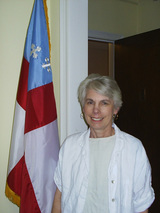
Maureen Shea, Director of Government Relations for the Episcopal Church
Maureen Shea, director of government relations for the Episcopal Church and chair of Churches for Middle East Peace (CMEP), traveled with a CMEP delegation to the Holy Land from December 1-12. The group visited Tel Aviv, Jerusalem, Bethlehem and Ramallah, and ended the trip in Amman, Jordan. They were not allowed to visit Gaza or the part of Hebron where there has been recent violence.
This was Shea's fourth trip to the Holy Land since joining the staff of the Episcopal Church more than five years ago. On each trip, she has met with religious leaders, church and NGOs, government representatives of both Palestinians and Israelis, as well as the United States, and individuals who struggle daily with the many hardships and challenges of living under Occupation.
The following is Shea's report about the trip.
As we prepare in the season of Advent to celebrate the birth of Jesus in Bethlehem, I am moved to reflect on the difficult conditions of Palestinian Christians. The context of the Occupation makes family life, jobs, educational opportunities, even worship, increasingly complicated. Christians living in the Occupied Territories of the West Bank, including Nazareth and Bethlehem, as well as Jerusalem, are leaving their families, the land of their birth, and the cradle of their faith.
The conditions of the Occupation include the ever-expanding Israeli settlements, the checkpoints of the Israeli Defense Forces, and the wall or security barrier which snakes through the West Bank. All of these conditions affect the ability of Palestinians to move from place to place. While recognizing the serious security issues Israelis face, it is incumbent to understand the devastating affects their solutions have had on all Palestinians. Those affects are having a significant impact on Christians whose numbers continue to dwindle.
Driving from Jerusalem to Bethlehem, our delegation of six faced the massive concrete barrier one must pass to reach the town and visit the Church of the Nativity. We were well aware that we could drive through after having our passports checked whereas Palestinians would not pass the checkpoint so easily. The massive barrier itself stands in painful contrast to the vision of unobstructed access to the places of Christ's birth and death.
Many Americans don't realize that there are, in fact, Palestinian Christians living in the Holy Land. Instead, visitors go to the Holy Sites, never stopping to meet those who the Palestinians refer to as the "living stones" of the land.
The Jerusalem Inter-Church Center estimates that there are 9,000 Christians living in Jerusalem, 50,000 in the West Bank and Gaza, and another 150,000 in Israel, many of them immigrants. According to the U.N., Christians currently make up fewer than 2% of the Palestinian population while historically the number has been much higher.
The combination of checkpoints and the wall/barrier and a series of complex laws and requirements imposed by the Israeli government are having a severe impact on the family life and worship of Palestinians. Israel does not allow those with Jerusalem or Israeli IDs to enter Palestinian territories without permission and vice versa. Thus, without special permission, Palestinian Christians are not allowed to visit their holy places except where they live. Neither Palestinian Christians living in Jerusalem nor Arab Christians living in Israel can go to Bethlehem without special permission and vice versa. While recently Israel has made some effort at easing the checkpoints at Christmas, there is no guarantee of access to Bethlehem for Palestinian Christians.
Permits for Jerusalem access are very difficult to obtain and limit entry points and duration of stay subject to cancellation at any time. The inability to move freely among the cities, towns, and villages where relatives reside is devastating to family life. Israeli residence laws are separating husband and wife, parents and children, thus fragmenting the vibrant family structure of Palestinians. For instance, if the spouse of a Palestinian resident of Jerusalem is not also from Jerusalem, they cannot legally live together. As a result, these married couples either live apart or, if they live together in Jerusalem, know that the "illegal" spouse could be sent away at any time. The Israeli Interior Ministry does not permit the registration of Palestinian children as Jerusalem residents if the child's father does not hold a Jerusalem ID card, even if the mother is a Jerusalem ID cardholder. One Episcopal priest told me that he lives in fear of his wife and young children being sent back to the Occupied Territories, but must stay where he is in order to make a living.
Clergy from abroad serving the Palestinian Christians and their institutions face particular obstacles. A 2008 State Department report noted that the Israeli authorities require that most Christian clergy serving in the West Bank or Jerusalem leave the country every 90 days to renew their tourist visas, disrupting their work and causing financial difficulties to their sponsoring religious organizations. A Catholic priest we met on this trip was so tired of dealing with the 90-day renewal issue that he was defiantly living and working in the Occupied Territories, helping the Christians and Muslims in his village and almost daring the authorities to expel him.
The Israeli government is prohibiting the vineyard outside of Bethlehem, run by the monks of the Cremisan monastery, to distribute their wine this Christmas. It is the beloved and highly symbolic wine used at communion not only by Palestinian Christians but in the United Kingdom, and the funds raised from its sale are used for projects supporting poor children in Bethlehem. Requests are being sent to the Archbishop of Canterbury to intervene.
The conditions facing Palestinian Christians are the same for all other Palestinians living under Occupation. Our own Episcopal advocacy work as well as that of Churches for Middle East Peace will continue to be for a just peace for all Palestinians and Israelis, recognizing that only when that is achieved will they be able to live in safety and security, each worshiping at the sites holy to their own faith.
 |