
Episcopal Press and News
Episcopal mission partner leaves Egypt temporarily
Episcopal News Service. February 7, 2011 [020711-05]
Matthew Davies
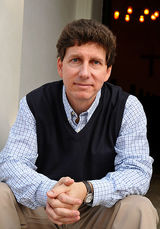
At the request of the Episcopal Church and due to the heightened security risks for Westerners residing in Egypt, the Rev. Paul-Gordon Chandler has temporarily left Cairo, where he has served as priest of an international Episcopal church since 2003.
Chandler says he hopes to return soon to his home in the Maadi district of Cairo, once the situation becomes less volatile.
On Feb. 7, anti-government demonstrations continued into their 14th day as the country's leaders and members of opposition movements met to discuss the possibility of political reform. President Hosni Mubarak announced Feb. 1 that he would not seek re-election when his term ends in November, but opponents and protestors are calling for his immediate resignation.
The government talks have included members of the Muslim Brotherhood, an Islamist political activist movement that is officially banned in Egypt.
Speaking on BBC Radio 4, Anglican Bishop Mouneer Anis of the Diocese of Egypt said, "There is no harm in having dialogue with all the groups and listening to all the groups, including the Muslim Brotherhood." But, he said, the hope is that all people in Egypt would have the freedom to practice any religion. Ani said that it was unclear where the Muslim Brotherhood stood on this issue.
Before the crisis some 90,000 Americans were living in Egypt. The U.S. Embassy is urging Americans to evacuate the country and the government began Jan. 31 to provide specially chartered flights for American citizens who wish to leave. The U.S. Embassy has now reduced its number of employees to what it qualifies as "essential staff," Chandler told ENS.
Chandler had intended to stay in Egypt to serve his few remaining parishioners – who are mostly international diplomats, members of non-governmental organizations, academics and business professionals – but "the situation deteriorated," he said, when some local media began to shift attention against foreigners, "who they see as 'interfering in their affairs' as many Western countries have vocalized their support of the protestors."
"Most expatriates have been evacuated," Chandler said. "Banks and the stock market were closed for over a week. Prices have begun to rise. Food, medical and other supplies dwindled since most factories and businesses are closed after last week's wave of vandalism … Unpredictability right now is the only known, it seems."
Many thousand prisoners have escaped since the anti-government protests began on Jan. 25; looters have robbed and set fire to several stores and some hotels have been completely ransacked.
"After the absence of the police from the streets, the burning of many police stations and escape of thousands of prisoners, many took advantage of the chaos to loot," Chandler said, noting that neighbors, both Christians and Muslims, came together on overnight shifts in order to protect their property. "We had some rough few days there, with numerous armed looter mobs trying to access our apartment building. It is amazing how quickly one becomes accustomed to the machine-gun fire."
Anis, president bishop of the Episcopal/Anglican Province of Jerusalem and the Middle East, said in an earlier statement that he'd been touched to see young adults, Muslims and Christians, guarding the streets, homes, and churches.
"We thank God for all our Egyptian neighbors (all Muslims) who literally protected us all," Chandler said in an e-mail update. "Despite the general turmoil, uncertainty, fear and many other emotions and realities of our situation, Christians are in no way being targeted or threatened. In fact, there are beautiful stories of how Muslims have been protecting churches from being looted."
"We are all praying for Egypt and are most encouraged with the positive signs, such as the wonderful Coptic Church service that Muslims helped facilitate on Tahrir Square," Chandler told ENS. "What an amazing image broadcast to the world. Muslims and Christians are discovering what they have in common through the necessity of defending their Egyptian way of life."
Chandler said he can't help but think about how the postponement of a major interfaith "Caravan Festival of the Arts," scheduled for this week, "has been replaced with the same intended outcome but on a vast scale. No matter what changes come about from the protest in the square, there has been a parallel revolution in the minds of people about their value to each other ... all made in God's image, regardless of creed."
 |